


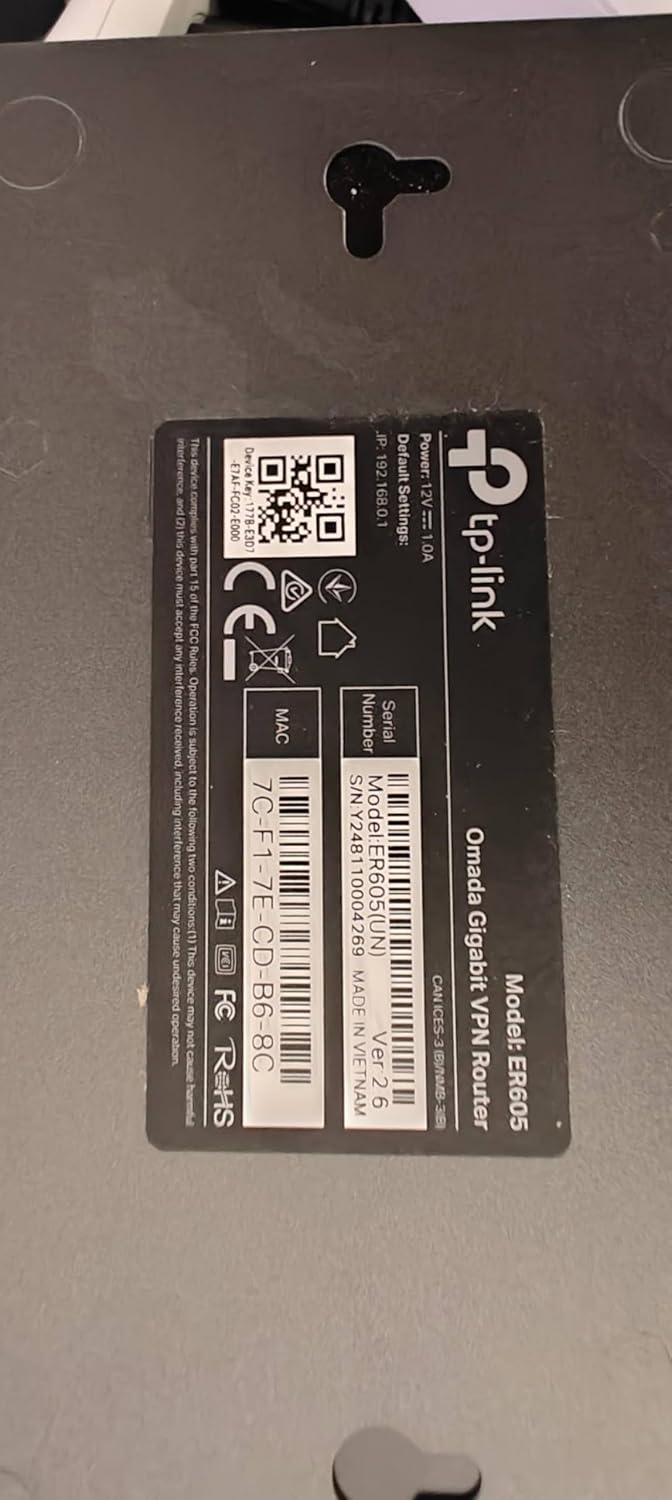
TP-Link ER605 V2 Wired Gigabit VPN Router, Up to 3 WAN Ethernet Ports + 1 USB WAN, SPI Firewall SMB Router, Omada SDN Integrated, Load Balance, Lightning Protection
Original price was: $59.99.$6.99Current price is: $6.99.


Multi-WAN Gigabit VPN Router with Omada SDN;The product is multiple voltage compatible, that voltage arrange is 100-240V.
【Five Gigabit Ports】1 Gigabit WAN Port plus 2 Gigabit WAN/LAN Ports plus 2 Gigabit LAN Port. Up to 3 WAN ports optimize bandwidth usage through one device.
【One USB WAN Port】Mobile broadband via 4G/3G modem is supported for WAN backup by connecting to the USB port. For complete list of compatible 4G/3G modems, please visit TP-Link website.
【Abundant Security Features】Advanced firewall policies, DoS defense, IP/MAC/URL filtering, speed test and more security functions protect your network and data.
【Highly Secure VPN】Supports up to 20× LAN-to-LAN IPsec, 16× OpenVPN, 16× L2TP, and 16× PPTP VPN connections.
Security – SPI Firewall, VPN Pass through, FTP/H.323/PPTP/SIP/IPsec ALG, DoS Defence, Ping of Death and Local Management. Standards and Protocols IEEE 802.3, 802.3u, 802.3ab, IEEE 802.3x, IEEE 802.1q
8 reviews for TP-Link ER605 V2 Wired Gigabit VPN Router, Up to 3 WAN Ethernet Ports + 1 USB WAN, SPI Firewall SMB Router, Omada SDN Integrated, Load Balance, Lightning Protection


Geewiz –
A Robust Router with a Quirky Interface
Our home is 4,000 sqft on two levels and the wifi distribution was built using an older Netgear wifi/router with a first generation Rockspace wifi mesh. As more smart devices, tablets, IOT’s and such being added, the system really began to choke and just couldn’t handle the load. That’s when I decided to rebuild the topology using a standalone router and upgraded wifi mesh.There isn’t a huge selection of standalone routers in the home networking category, and the selection came down between Ubiquity and TP-Link. I settled on the TP-link ER605 and am very pleased with the overall results, though it did come with pretty steep learning curve, due to its (in my opinion) confusing GUI interface.For instance: setting a DHCP address pool is hidden within a category called “Network List”. All that is displayed is a Network Name “LAN”, the IP address of the router, and a couple other parameters. You must select an edit icon to expand the display which will allow you to customize your LAN set up. It’s subtle, and easy to miss if you don’t understand the GUI design intention of the programmers at TP-Link.The MAC/IP Reservation controls are straightforward, but there is no obvious way to sort the list by IP or MAC address. I have nearly 70 devices hanging off my network, and not being able to sort the lists makes for a tedious effort when looking for a specific device. I contacted TP-Link support about this and told me that, no, you cannot sort the DHCP IP listing, but you can if you use their add-on OMADA Hardware Controller (at a cost of about $100), but I really don’t want another layer of hardware or complexity to deal with.There are other quirks in the interface that slowed my setup time, only because I had to spend more time just to find where the specific option I was looking for is buried within the GUI. Now, anytime you migrate to a new topology, there will be a learning curve, but most of the quirks I ran up against could easily be addressed with a bit of effort on the GUI design.Things like Port Forwarding (Called “Virtual Servers” in the GUI), Dynamic DNS, and OpenVPN services are all there and are fairly straight-forward to set up. So, overall, this little modem has delivered everything I expected and need and this, coupled with the new wifi mesh system (Eero 6+ with 4 nodes with backhaul to the router) has dramatically improved our overall network and wifi service throughout the house.The ER605 modem has proven to be very well suited and is a fast and efficient workhorse of a router. With a bit of pain, effort, and patience to get through the learning curve of the interface, there will be only a few minor disappointments in the interface.
Aaron C. –
cheap, fast, easy
used this to offload some processing from my mesh network. worked perfectly. i see a lot of people complaining it was tough to set up. initial setup was very easy for me. getting ipv6 working was not cut and dried but youtube saved the day
Michael A. –
Supports redundant WAN (ISP Uplink) and basic VLAN
This product is marketed to small business needs, I am using it for a home router, and it works well for that but requires some technical aptitude.Our old WiFi 5 (802.11ac) system was dying. Big house, need at least two access points. Our access point died (would lose connectivity once a week, then once a day) and our combo router/access point was starting to have issues, so it was time to replace it.I went with TP-Link Omada specifically because I wanted affordable ceiling-mount access points that uplink (backhaul) over Ethernet and can be individually replaced/upgraded as needed, separate from the router.I wanted Omada because of the ease of administration of everything through a single interface.The ER605v2 is the least expensive TPLink Omada based router I could find and I like the fact that it offers the ability to connect to two separate WAN uplinks for redundancy.It does have a stand-alone configuration interface but I’m using an Omada hardware controller to configure it.It’s boot time is longer than I would like but since the initial setup I have not had to reboot it. I do recommend a UPS so that it doesn’t need to be booted after a power failure.The Omada controller interface can be somewhat confusing to understand but once you have it doing what you want it to do, it just works.I get the full gigabit download/upload my ISP offers.For a router without built-in WiFi, this is an excellent option *especially* if you plan to use Access Points controlled by an Omada controller.I was able to do some basic VLAN configuration (e.g. separating IoT devices from main LAN) with it despite not having any L3 switches on my network, but for some VLAN capabilities apparently you need one model up (ER7206).It works well.I have not (yet) tried the VPN features.
Daniel Lapierre –
Très bon routeur, connaissance requise pour les configuration avancé.Recommander
Michele –
perfetto
anonymous user –
I have been using this for more than a week, overall good product. Must but if you want to use with multiple internet connections in one networkPros: extremely easy user interface5x gigabit portsWAN fail and load balancingSmall form factorNo need for omada contollerSetup and forget configurationsCons: don’t use with omada contoller. Horrible placement of options.WAN connection polling time cannot be set in standalone modeSome settings require hard reboot to apply, auto soft reboot not reflecting the settingsThe order of WAN port number is reversed for working order, last WAN is default not the first one
ST –
Great product
Alexander Joseph –
I bought this unit because I only have vdsl. I bought a second line to gain more bandwidth. I I run alot of services in my homelab. Even when I’m downloading or uploadeding large files it only sits at 60 percent. Great for people who need a backup line or load balance between 4 connections. I it has good fetures like port forwarding and all standerd networking. I works with cloudflare tunnels